Most adults in Queensland should have a full skin check with a GP once a year. If you have had skin cancer before, have a lot of moles or have a family history of melanoma, your doctor may want to see you every 6 to 12 months. Between visits, check your own skin about every three months.
Australia has one of the highest rates of skin cancer in the world, and Queensland has the highest rate of melanoma in the country. At Gympie Day and Evening Clinic, our GPs offer skin cancer checks in Gympie 7 days a week, with appointments until 9pm on weeknights. This guide explains how often you need a check, what happens during one, and which changes mean you should book sooner.
How often should you get a skin check?
How often you need a check depends on your risk. Use this as a guide, then ask your GP what suits you.
| Your risk | Who this usually includes | Check your own skin | Full skin check with a GP |
|---|---|---|---|
| Average | Most adults with no history of skin cancer | About every 3 months | Once a year for most Queenslanders |
| Higher | Fair skin that burns easily, many moles, a lot of past sunburn, outdoor work | About every 3 months | Every 6 to 12 months, or as your GP advises |
| High | Previous skin cancer, a parent, brother or sister with melanoma, a weak immune system | Every month or as advised | Every 3 to 6 months, or as your GP advises |
Any new or changing spot is a reason to book straight away. Do not wait for your next routine check.
Who has a higher risk of skin cancer?
Anyone can get skin cancer, whatever their skin colour. Your risk is higher if you:
- have fair or freckled skin that burns rather than tans
- have red or fair hair and light-coloured eyes
- have a lot of moles, or moles that look unusual
- had bad sunburns as a child or teenager
- work outdoors or spend a lot of time in the sun for sport or hobbies
- have used solariums in the past
- have had skin cancer before
- have a close family member who has had melanoma
- take medicines that weaken the immune system, for example after an organ transplant
- are over 40
Why skin checks matter more in Queensland
Cancer Council Australia estimates that two in three Australians will be diagnosed with skin cancer by the age of 70. Skin cancers make up around 80% of all new cancers found in Australia each year.
In Queensland, the UV index is 3 or higher for most of the year. At that level, SunSmart advises sun protection every day, not only in summer. Gympie and the Cooloola Coast get strong UV even on cool or cloudy days, which is why our GPs suggest a yearly check for most adults who live here.
What happens during a full body skin check?
A full skin check with one of our GPs takes about 30 minutes. Here is what to expect:
- A few questions. Your doctor asks about your skin type, past sunburns, any skin cancers you or your family have had, and any spots that worry you.
- A head to toe look. You undress down to your underwear. The doctor checks all of your skin, including your scalp, behind your ears, between your toes and the soles of your feet. Melanoma can grow on skin that never sees the sun.
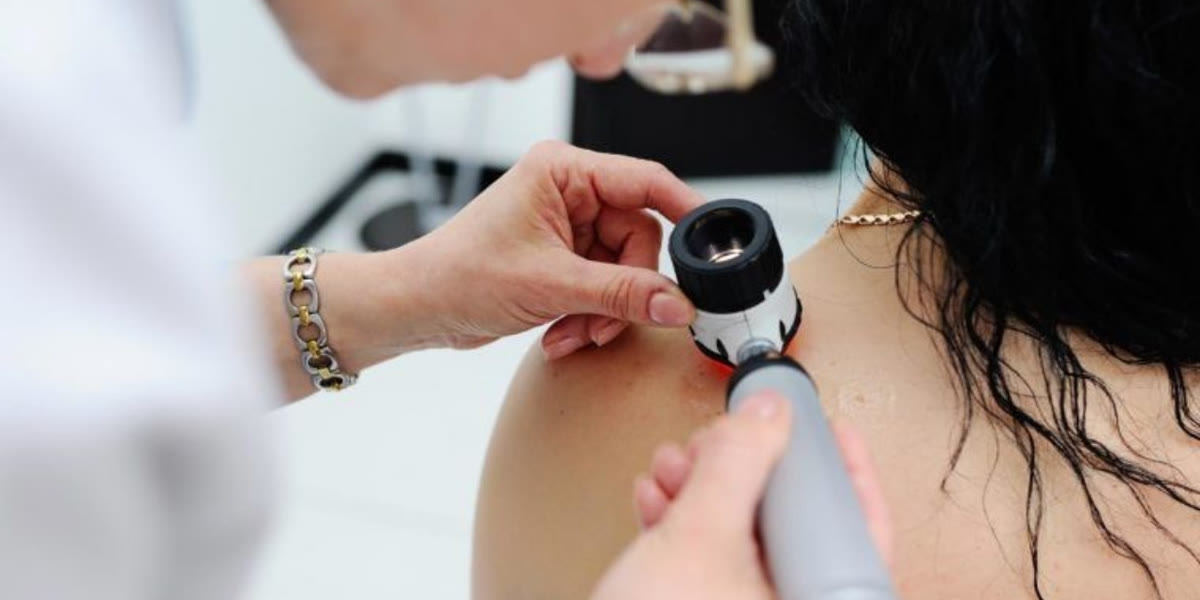
- Dermoscopy. Your doctor looks at any spot of concern through a dermatoscope, a small hand-held magnifier with a light. It shows patterns under the skin surface that the eye cannot see.
- A plan. Most spots are harmless. If one looks unusual, your GP may take a photo to compare next time, remove a small sample (a biopsy), or remove the spot completely.
Before your check: take off nail polish and make-up, and leave your hair loose so your scalp can be checked. Write down any spots you want looked at.
How to check your own skin at home
Checking your own skin helps you spot changes early. Do it in good light, with a full-length mirror and a hand mirror, or ask someone to check your back and scalp.
Look for a spot that is new, or one that is changing. The ABCDE guide helps:
- Asymmetry: the two halves of the spot do not match
- Border: the edge is uneven, blurred or notched
- Colour: more than one colour, or a mix of brown, black, red, white or blue
- Diameter: wider than about 6 mm, or getting bigger
- Evolving: changing in size, shape, colour or height
Some melanomas grow fast and do not fit ABCDE. Doctors use EFG for these: Elevated (raised), Firm to touch, and Growing over a few weeks. A spot like this needs a GP visit within days.
When to see a GP about a mole
Book a skin check soon if you notice:
- a new spot, especially if you are over 40
- a mole that changes in size, shape or colour
- a spot that bleeds, itches, crusts or does not heal within a few weeks
- a scaly patch or a lump that keeps coming back
- a spot that looks different from your other moles (sometimes called the “ugly duckling”)
Most of these turn out to be harmless. When a skin cancer is found early, treatment is usually simpler and the result is better.
Skin checks at Gympie Day and Evening Clinic
Our GPs check skin every day and can treat many skin cancers in the clinic. We offer:
- full body skin checks with dermoscopy
- biopsies to confirm a diagnosis
- excision (removal) of skin cancers and suspicious spots
- cryotherapy (freezing) for sunspots
- wound care and follow-up after treatment
- referral to a dermatologist or plastic surgeon when needed
Dr Htun Wai Yan Lwin has a special interest in skin cancer surgery. We are open Monday to Friday until 9pm and on weekends, so you can book a check after work. Coming to us for the first time? Read our new patient information before your visit.
Book a skin check online or call (07) 2140 4888. We are at Shop 5-6, 30 Excelsior Road, Gympie.
Frequently asked questions
A full body skin check with one of our GPs takes about 30 minutes. If a spot needs a biopsy or removal, your doctor may do it at a later appointment.
No. You can book a skin check directly with a GP. Your GP will refer you to a dermatologist or plastic surgeon if you need one.
There is no set age. Adults in Queensland should start checking their own skin regularly and talk to their GP about how often they need a full check. Children’s skin can be checked as part of a normal GP visit if a parent is worried about a spot.
Self-checks help you find changes early, but they do not replace a full check by a doctor. A GP can see areas you cannot and can look at spots with a dermatoscope.
No. The check is a visual exam with a magnifier. If a biopsy is needed, the doctor uses a local anaesthetic to numb the area first.
Sources: Cancer Council Australia, Cancer Council Queensland, SunSmart, Healthdirect, Melanoma Institute Australia
This article is general information and does not replace advice from your doctor. If you are worried about a spot on your skin, book an appointment with a GP.