
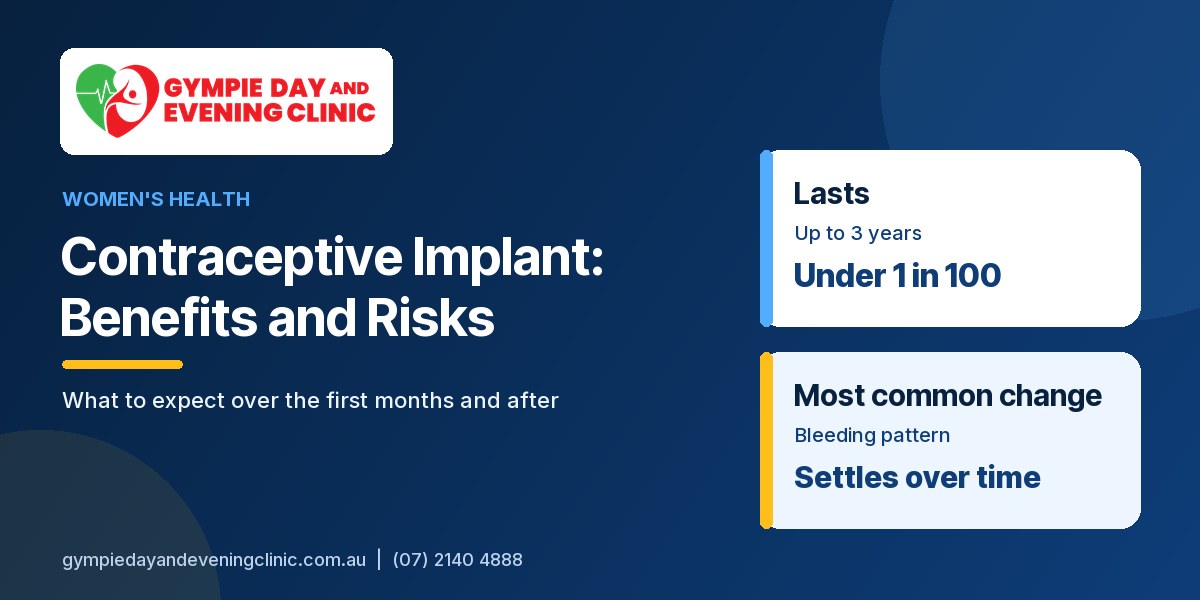
The contraceptive implant is a small rod that sits under the skin of your upper arm and releases a steady low dose of hormone. Once it is in place, it works for up to 3 years without any daily tablets or monthly reminders. It is one of the most effective contraceptive methods available, with fewer than 1 in 100 women becoming pregnant in a year.
Like every hormonal method, the implant has trade-offs. The most common one is a change in your bleeding pattern. This guide explains the benefits, the side effects and risks, what to expect over the first few months and when to see your GP.
What is the contraceptive implant?
The implant is a thin, flexible rod about the size of a matchstick. It contains etonogestrel, a progestogen, and releases it slowly into the bloodstream. The hormone stops ovulation in most women, thickens the cervical mucus so that sperm have a harder time getting through, and thins the lining of the uterus.
The implant is placed under the skin of the inner upper arm by a GP. Our clinic offers Implanon insertion and removal on-site, after a prior consultation.
Benefits of the implant
- Long-lasting. It works for up to 3 years.
- Very effective. Fewer than 1 in 100 women become pregnant in a year with the implant.
- No daily or monthly action. You do not need to remember a pill or change a ring.
- Safe with breastfeeding. It is an option for many breastfeeding women, but talk to your GP first.
- Fertility returns quickly. You can have it removed at any time, and most women can get pregnant soon after.
- Can be used when estrogen is not suitable. It contains progestogen only, so it may suit women who cannot take combined hormonal methods.
Side effects and risks
Most side effects are linked to the hormone and tend to settle over time:
| Side effect | What to expect | How common |
|---|---|---|
| Irregular bleeding | Spotting, or bleeding between periods, especially in the first 3 to 6 months | Very common |
| Changes to periods | Lighter periods, or no periods at all after several months | Common, and not harmful |
| Headaches | Mild, often in the first few months | Common |
| Mood or acne changes | Some women notice changes in mood or skin | Less common |
| Breast tenderness | Mild soreness | Less common |
| Weight change | Women’s experiences vary, so raise any concern at a review | Varies |
Risks linked to the insertion and the implant itself are uncommon:
- Bruising, soreness or swelling at the insertion site for a few days
- A small scar at the insertion site
- Infection at the site, which is rare but needs a GP visit if it occurs
- The implant moving or being hard to find. Your GP can check where it is, and it can usually be removed
Some medicines can reduce how well the implant works. These include certain anti-seizure medicines, some HIV medicines and St John’s wort. Tell your GP about everything you take, including supplements, before you have the implant.
What to expect in the first few months
Here is a rough timeline:
| When | What is normal | What to do |
|---|---|---|
| Day 1 to 2 | Soreness and bruising at the arm | Keep the area clean and dry. Paracetamol can help the soreness. |
| First 1 to 2 weeks | Spotting, mild cramps and tender breasts are possible | Keep a note of any bleeding pattern to share at review. |
| First 3 to 6 months | Irregular bleeding is most common | Most women settle as the body adjusts. Book a review if bleeding is heavy or worrying. |
| 6 months onwards | Periods may become lighter, less frequent or stop | No action needed unless you have concerns. |
| Up to 3 years | The implant keeps working | Your GP can check it and arrange removal or replacement when it is due. |
You can feel the implant under the skin, so you can check that it is still in place. If you cannot feel it, or it seems to have moved, see your GP promptly and use another method until it is checked.
When to see a GP
Book an appointment if:
- your bleeding is heavy, lasts a long time or bothers you
- you have pain, redness or swelling at the arm that gets worse, or a fever
- you have headaches that are severe or keep coming back
- you think you may be pregnant, or your period is very late
- you want to stop the implant, or you want to replace it when it is due
- you are taking a new medicine that might affect the implant
Call 000 for severe chest pain, sudden severe headache with weakness or trouble speaking, or trouble breathing.
Who should talk to a GP first?
Your GP will check your health history before recommending the implant. Tell them if you have or have had:
- blood clots or a clotting disorder
- breast cancer or a history of certain hormone-sensitive cancers
- liver disease
- unexplained vaginal bleeding
- migraines with aura
Some conditions mean the implant is not the best choice. Your GP will explain your options and compare them with methods such as the Mirena IUD or the copper IUD.
Contraceptive implant care at Gympie Day and Evening Clinic
Our GPs offer Implanon insertion and removal on-site after a prior consultation. Procedures are privately billed at our clinic, so please call (07) 2140 4888 for the current fee before booking. A female GP is available on request. Appointments run on weekday evenings until 9 pm and on weekends. Learn more about Implanon insertion and removal in Gympie, or compare your options in our guide to contraception options. You can also book an appointment online.
Frequently asked questions
Up to 3 years. It can be removed earlier if you want.
Weight change varies between women and is not well proven either way. If you notice a change, raise it at your review.
Some women stop having periods, and others have lighter or irregular bleeding. Both are common and not harmful.
Yes, usually. A GP can check that it is in place.
Most women can get pregnant soon after the implant is removed. Fertility usually returns quickly.
Sources: Family Planning NSW, RANZCOG Contraception guidance, Healthdirect, Australian Government Department of Health