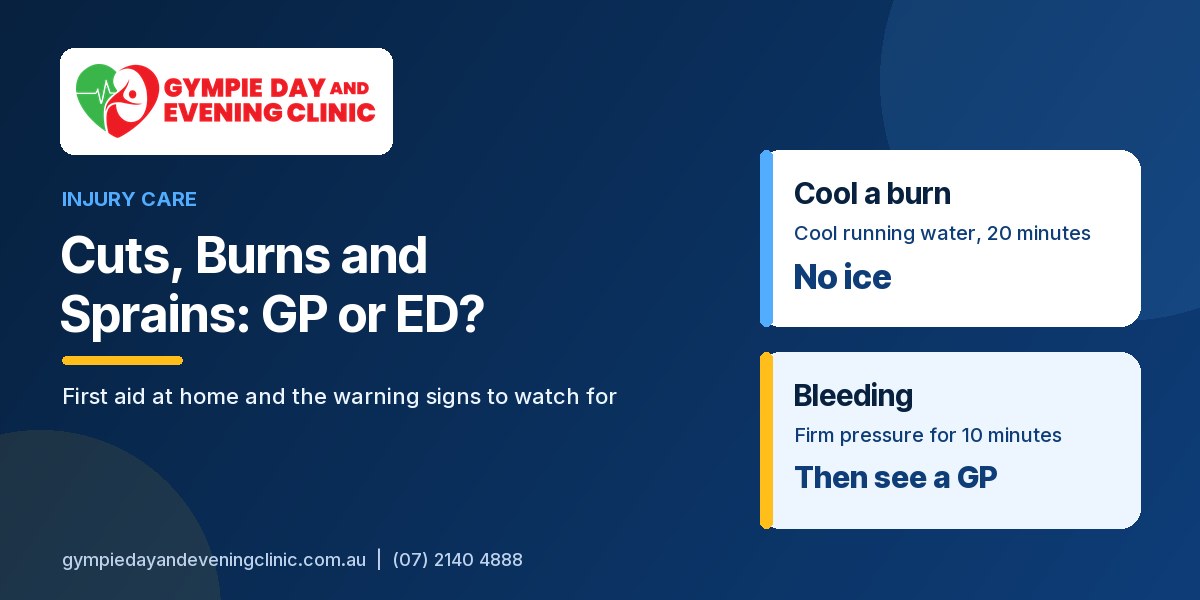
Many cuts, burns and sprains can be treated at home or by a GP, without a trip to the emergency department. Knowing which injuries are minor, and which need urgent hospital care, can save you hours in a waiting room. The right choice depends on how deep the cut is, how large or deep the burn is, whether you can move the joint and whether there are warning signs.
This guide covers first aid for each type of injury, when a GP visit is enough and the red flags that mean you should go to hospital. It is general information, not a substitute for medical care. If you are unsure, call Healthdirect on 1800 022 222 for free advice from a registered nurse, or call 000 in an emergency. Our GPs can assess many of these injuries as part of our family medicine services in Gympie.
Cuts and grazes
For most minor cuts, first aid at home is enough:
- Stop the bleeding with firm, steady pressure for about 10 minutes.
- Rinse the wound under cool running water and remove any dirt.
- Cover it with a clean dressing and change it daily, or when it gets wet.
- Watch for signs of infection over the next few days.
| Cut type | What to do |
|---|---|
| Small, shallow cut that closes when the edges are held together | First aid at home, then a GP if it is not healing |
| Gaping cut where the edges do not come together | GP or urgent care soon, because it may need stitches |
| Deep cut with visible fat, muscle or bone | Go to the emergency department |
| Bleeding that does not stop after 10 minutes of firm pressure | Call 000 or go to the emergency department |
| Puncture wound, bite or cut from a dirty object | See a GP the same day, as you may need a tetanus booster or antibiotics |
Cuts that need stitches work best when they are closed within a few hours of the injury, so do not delay if the wound is deep or gaping.
Burns
Cool the burn under cool, running water for at least 20 minutes as soon as possible. Do not use ice, butter or toothpaste. After cooling, cover the area loosely with a clean, non-stick dressing.
| Burn | What to do |
|---|---|
| Small burn, smaller than a 20 cent coin, with no blisters | First aid at home, and watch for worsening |
| Burn larger than about 3 cm, or with blisters | See a GP for assessment |
| Burn on the face, hands, feet, genitals or a joint | See a GP or go to hospital, as these areas need extra care |
| Electrical burn, or a burn that looks white or charred | Go to the emergency department, even if it looks small |
| Burn that is getting worse, or infected | See a GP promptly |
A partial thickness burn usually heals within 1 to 3 weeks. Keep the area clean, avoid popping blisters and protect the skin from the sun while it heals.
Sprains
A sprain is a stretched or torn ligament, usually in the ankle, knee or wrist. Rest, ice, compression and elevation (RICE) are the usual first steps in the first 48 hours. Apply an ice pack wrapped in a cloth for about 10 minutes at a time, and do not put ice directly on the skin.
| Sprain sign | What it may mean |
|---|---|
| You can walk on the joint with some pain | Often a mild sprain that can be managed at home or by a GP |
| You cannot put weight on the joint | See a GP or go to hospital for an assessment |
| The joint looks deformed or is very swollen | Go to the emergency department |
| Pain, swelling or stiffness is getting worse | See a GP |
| Not better after about a week | See a GP or physiotherapist |
An X-ray may be needed to check for a broken bone. Your GP can decide if one is needed using the signs of injury, so you do not always need one for a simple sprain.
When to go to the emergency department
Go to the emergency department or call 000 if you have:
- bleeding that will not stop, or a deep wound
- a burn that is large, electrical, or looks white or charred
- a joint that looks out of place, or you cannot move a limb
- numbness, tingling or a cold, pale or blue limb
- a head injury with vomiting, confusion or drowsiness
- trouble breathing after an injury
When to see a GP
Book an appointment if:
- a cut needs closing, or a wound is not healing
- a burn has blisters, or you are worried about it
- a sprain is still painful after a few days
- you are not sure when you last had a tetanus booster, especially after a dirty or puncture wound
- the injury happened at work. Our WorkCover service can help with the paperwork.
If you cannot get a same-day appointment, a phone or video GP visit can help you decide what to do next. Your GP will tell you if you need to be seen in person.
Injury care at Gympie Day and Evening Clinic
Our GPs assess cuts, burns and sprains, check wounds and give clear advice on when to wait and when to be seen. Appointments run on weekday evenings until 9 pm and on weekends, which is useful if an injury happens after work. If you are looking for care outside normal hours, see our after-hours GP information. You can also book an appointment online.
Frequently asked questions
Go to the ED for deep wounds, wounds with visible fat, muscle or bone, or bleeding that will not stop after 10 minutes of firm pressure.
Wounds that need closing work best when they are treated within a few hours of the injury. Do not delay if the cut is deep or gaping.
Cool the burn under cool running water for at least 20 minutes, then cover it loosely with a clean, non-stick dressing. Do not use ice.
Not always. A GP can check the injury and decide if an X-ray is needed to rule out a broken bone.
Yes. Many sprains and minor burns are assessed and managed by a GP, and a GP can refer you for imaging or specialist care if needed.
Sources: Healthdirect burns and scalds, Healthdirect sprained ankle, Healthdirect wounds, cuts and grazes, Better Health Channel, Raising Children Network