Medical cannabis is a prescription treatment in Australia. It is regulated by the Therapeutic Goods Administration (TGA), and it is not available over the counter or from a shop. Some cannabis-based medicines are registered and can be prescribed through the normal pathway. Other products need special approval from the TGA before a doctor can prescribe them. This guide explains the eligibility rules, the TGA access routes, what a GP does and what to expect at your appointment.
It is general information. Whether medical cannabis is suitable for you depends on your condition, your other medicines and your health history. Our clinic discusses this option as part of our medicinal cannabis service in Gympie.
What is medical cannabis?
Medical cannabis refers to medicines that contain cannabinoids from the cannabis plant, mainly THC and CBD in different ratios. In Australia, these products are regulated as medicines, so the dose, quality and labelling must meet TGA standards. Two types exist:
| Type | What it means |
|---|---|
| Registered medicines | Products listed on the Australian Register of Therapeutic Goods (ARTG). A GP can prescribe them through normal prescribing rules |
| Unregistered products | Products that need TGA approval for each patient or group of patients before they can be prescribed |
Who might be considered?
A GP may consider medical cannabis when standard treatments have not worked well or are not suitable. Examples include some forms of chronic pain, nausea linked to chemotherapy, muscle stiffness linked with multiple sclerosis, and some rare forms of epilepsy. Evidence differs between conditions, and not every condition is suitable.
Medical cannabis is not right for everyone. Your GP will review any history of psychosis, heart problems, substance use, pregnancy or breastfeeding, and any other medicines you take, because cannabis products can interact with other medicines.
The two TGA access routes
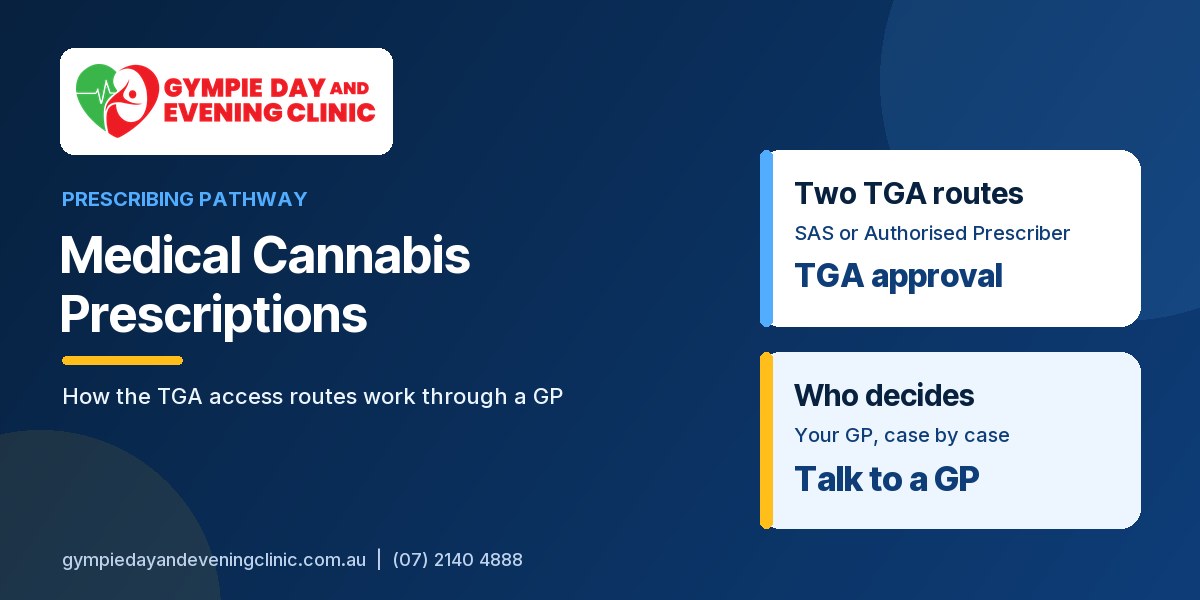
Unregistered medical cannabis products can be accessed through two TGA schemes. The route depends on whether the product is for one patient or several patients with the same condition.
| Route | Who it is for | Who can apply |
|---|---|---|
| Special Access Scheme (SAS) | One patient, for a specific medical need | Doctors, and nurse practitioners under SAS |
| Authorised Prescriber (AP) scheme | Several patients with the same condition | Doctors only, once approved as an authorised prescriber |
Applications are made through the TGA’s online system. Applications name the active ingredient and its cannabinoid content category, not a brand name. Approval is decided case by case, so the timeframe can vary.
What happens at a GP appointment
| Step | What your GP does |
|---|---|
| 1. Review your history | Checks your condition, previous treatments and current medicines |
| 2. Check your state rules | Some states and territories have extra approval steps before a doctor can prescribe |
| 3. Discuss options | Explains the benefits, side effects and what is still unknown |
| 4. Apply to the TGA | Submits the application through the correct scheme, sometimes with specialist support |
| 5. Prescribe and follow up | Arranges a prescription if approved, then reviews your response and side effects |
A pharmacy can supply medical cannabis on a valid prescription, but it may need TGA approval details before it can order the product. Costs vary, and many products are not covered by the PBS, so ask about the cost before you start.
Driving and safety
Medical cannabis can affect concentration, reaction time and coordination. Drug driving laws apply to prescribed medicines as well. In Queensland, it is an offence to drive while impaired by a drug, including medical cannabis. Do not drive or operate machinery until you know how the medicine affects you.
Store the medicine safely, away from children and pets, and keep it in its original packaging.
Other options to discuss with your GP
Medical cannabis is one option among several. Your GP may also discuss:
- psychological support, including a GP mental health care plan where it fits your needs
- other medicines for pain, nausea, sleep or anxiety that have stronger evidence for your condition
- lifestyle measures and physiotherapy, which can reduce symptoms for some people
When should you see a GP?
Book an appointment if:
- your symptoms are not controlled by your current treatment, and you want to explore all options
- you have been told by a specialist that medical cannabis may help
- you already use cannabis products and want to talk about safe use
- you have a condition that may affect your suitability, such as heart disease or a history of mental health problems
Call 000 if you have chest pain, severe breathlessness, a seizure, or sudden confusion or hallucinations after taking any cannabis product.
Medicinal cannabis consultations at Gympie Day and Evening Clinic
Our GPs talk through whether medical cannabis is suitable, explain the TGA pathway and arrange follow-up. A longer appointment helps if you want to weigh up the options in detail. Appointments run on weekday evenings until 9 pm and on weekends. You can read more about our medicinal cannabis service, or book an appointment online. If you are new to the clinic, our first GP appointment guide explains what to bring.
Frequently asked questions
Yes, when it is prescribed by a doctor and supplied under TGA rules. Cannabis obtained outside these rules is not legal as a medicine.
Doctors can prescribe it. Unregistered products need TGA approval, through either the Special Access Scheme or the Authorised Prescriber scheme.
Your GP consultation is billed through Medicare as usual, but many medical cannabis products are not on the PBS, so the medicine itself is often paid for privately. Ask about costs before you start.
It depends on the scheme and the case. Your GP can tell you what to expect for your situation.
Only if the medicine does not affect your driving. Drug driving laws apply, so talk to your GP and check before you drive.
Sources: Therapeutic Goods Administration, National Prescribing Service, RACGP, Healthdirect