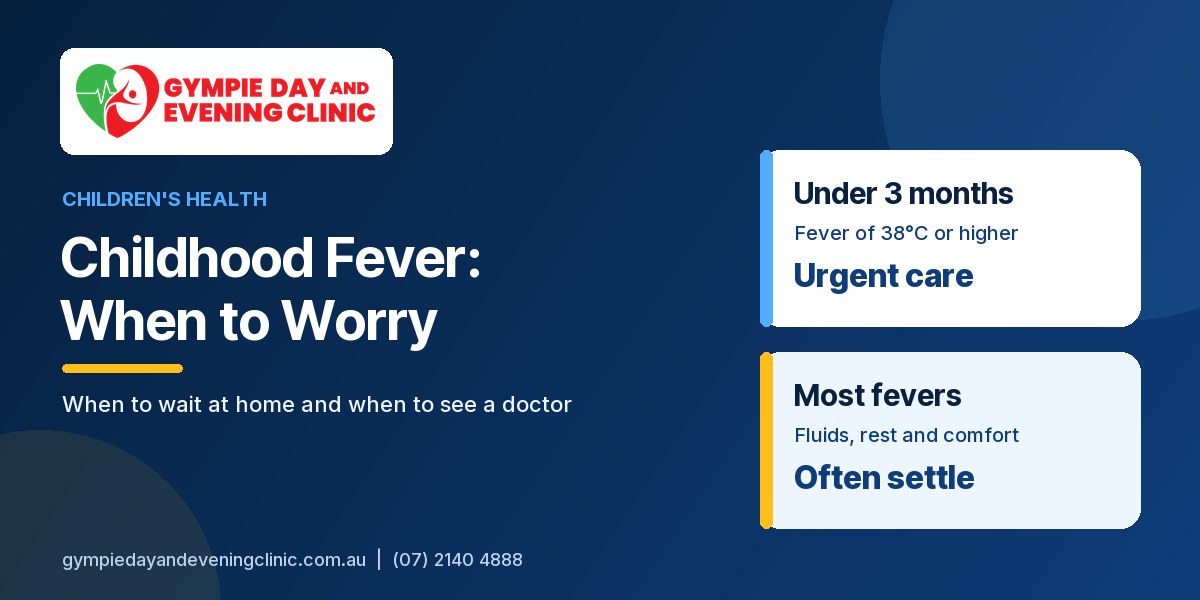
A fever is a temperature of 38°C or higher. Most fevers in children are caused by common viral infections, and they usually settle within a few days without any treatment beyond rest, fluids and comfort. The harder question for parents is when a fever needs a doctor straight away. The answer depends mostly on your child’s age and how unwell they look, not only on the number on the thermometer.
This guide explains when to wait at home, when to call your GP and when to get emergency care. It is general information. If you are unsure, call your GP or after-hours service, because a parent’s concern is a good reason to get advice. Our team offers children’s health care as part of our services in Gympie.
What counts as a fever in children?
Use a thermometer rather than the feel of a forehead. A temperature of 38°C or higher is generally called a fever. Temperature alone does not tell you how serious an illness is. A child with a mild fever who is playing and drinking can be less unwell than a child with a lower temperature who is floppy or hard to wake.
| Measurement | What it means |
|---|---|
| Under 38°C | Not a fever, even if your child feels warm |
| 38°C or higher | A fever. Check your child’s age and symptoms before deciding what to do next |
| Fever with signs of serious illness | Seek urgent care, whatever the temperature |
When to go to emergency care
Some fevers need urgent assessment, even if your child seems otherwise fine.
| Situation | What to do |
|---|---|
| Baby under 3 months with a temperature of 38°C or higher | Go to the nearest emergency department straight away, even if the baby seems well |
| Trouble breathing, grunting or chest sucking in | Call 000 or go to the nearest emergency department |
| Hard to wake, very floppy or not responding normally | Call 000 or go to the nearest emergency department |
| Seizure or fit | Call 000, especially if it is the first time |
| Rash that does not fade when you press a glass against it | Call 000 straight away |
| Stiff neck, or severe headache with vomiting in an older child | Seek urgent care |
Healthdirect and the NHMRC both advise that a baby under 3 months with a fever should be seen urgently, with no waiting to see whether it settles.
When to see your GP the same day
Book a GP appointment, or call your GP’s after-hours line, if:
- your child is under 3 months and the temperature is below 38°C, but they seem unwell or are feeding poorly
- your child is not drinking well, or has fewer wet nappies or fewer trips to the toilet than usual
- your child has ear pain, a sore throat, a painful cough or pain when passing urine with the fever
- the fever is high and does not improve with fluids and paracetamol or ibuprofen
- your child has a medical condition that makes them more prone to infection, or has had a recent surgery
- you are worried, and your child is not getting better
When you can wait at home
Many children with a fever are well enough to stay home. You can wait and watch if your child:
- is drinking and passing urine as usual
- wakes up and responds to you, and plays when the fever comes down
- has no signs of breathing difficulty or a rash that does not fade
- has a fever that comes with a runny nose, a mild cough or a sore throat
Keep your child cool and comfortable. Dress them in light clothing, offer regular fluids and let them rest. Do not wrap them up in blankets.
Fever medicines for children
- Ibuprofen can be given to children aged 3 months and older to ease pain and fever. Follow the dose on the packet for your child’s weight and age.
- Paracetamol is also used for children, with doses based on weight and age.
- Do not give aspirin to children unless a doctor specifically tells you to.
- Medicine does not need to bring the temperature down to normal. Its main job is to make your child more comfortable.
- Ask your pharmacist if you are unsure about the dose or which medicine to use, especially if your child has a medical condition.
Febrile seizures
Some children have a febrile seizure, a fit that happens when a temperature rises quickly. Most febrile seizures are brief and do not cause lasting harm. Even so, your child should be checked by a doctor to look for a serious infection. If a seizure lasts more than a few minutes, call 000.
When should you see a GP?
Book an appointment soon if your child has:
- a fever that lasts several days, or keeps coming back
- a new rash, even if your child seems well
- signs of an ear infection, a urinary infection or a chest infection
- a fever after recent travel, or after contact with someone who is unwell
- vaccines that are due or overdue, which you can check in our childhood immunisation schedule guide
If you cannot get a same-day appointment, a phone or video GP visit can be a quick way to talk through your child’s symptoms. A phone or video visit is not right for every child, so your GP will tell you if your child needs to be seen in person.
Children’s health care at Gympie Day and Evening Clinic
Our GPs assess children with fevers and other common illnesses, explain when to wait and when to be seen, and talk parents through treatment. Appointments run on weekday evenings until 9 pm and on weekends, which can help busy families. You can learn more about our children’s health services or book an appointment online.
Frequently asked questions
A temperature of 38°C or higher is generally called a fever. Measure with a thermometer and look at how your child is behaving too.
A baby under 3 months with a temperature of 38°C or higher needs urgent medical assessment, so go to the nearest emergency department straight away.
Ibuprofen can be given to children aged 3 months and older. Follow the dose for your child’s weight and age, and ask your pharmacist if you are unsure.
Most are brief and do not cause lasting harm, but your child should still be checked by a doctor. Call 000 if a seizure lasts more than a few minutes.
Many viral fevers last two to three days. See a GP if the fever lasts several days or your child is getting worse.
Sources: Healthdirect, NHMRC, Pregnancy, Birth and Baby, Australian Government Department of Health